Thursday, February 26, 2015

Second time in Tissa & Katharagama in 2014

Dates: - 20th and 21st December 2014

Crew: - Family

Transport: - car

Katharagama and Tissa are two places that we customary visit. We try to stay in different locations in close proximity in each stay. Last time, we stayed in “Kodigahawewa Forest Resort” in Julle Pallamalma in April this year and this time it was “Taprospa –Tissa”. My previous blog: - http://simple-travels.blogspot.com/2014/06/katharagama-pilgrimage-april-2014.html was an article about our previous visit. 

There are two routes; Rathnapura-Udawalawe Road and A2 from Matara Side. First route is 40 km’s lesser than the second. There are about 230 to 240 km’s from Ganemulla to Tissa and I took 6 hours with two stoppages for breakfast and lunch.

This was our 3rd stay in this hotel but the first blog article about the place. Before the booking, we went through travel webs about the hotel and saw quite a few bad comments. Taprospa-Tissa is found facing the Tissa Lake and it has a panoramic view of the Tissa Lake and its surround. Whatever the comments about facilities and food, this place can’t be given away as its relaxing, elegant and breathtaking atmosphere of “Tissa Wewa”.  

Tissa wewa is a man-made lake and it is one of the large tanks in the southern part of Sri Lanka. This wewa was built to provide water for irrigation and Tissamaharama city in those days as well as today and it was restored during the British era. Embankment is now used as the road goes to Katharagama. Since wewa is close to birds’ sanctuary, a large crowd of aquatic birds can be seen such as herons like egrets, bitterns and other wildlife as well. There is an island in the wewa, which is called “Kok Duwa”, we had been there once before by a boat (not this time) and observed large crowd of herons. But this “Duwa” is not clearly visible from Taprospa-Hotel. Flocks of egrets were seen descending onto trees in the boundary especially in the evening.  


There are wetlands adjoined and around Thissa Wewa. I walked along a gravel road that goes parallel to the wewa to interior villages of the eastern part. After few hundres of meters that becomes a narrow foot path through a wetland. I observed different kind of birds and wild creatures, but I was unfortunate to capture those by my basic camera. 


 Couples of fishing boats were seen on the edge of the wewa and those were parked nearby small houses. I’ve not seen anybody other than a small boy and her mother and inquired them about fishing, her reply was that they do fishing only in the morning and in the evening but not in the middle of the day. 

This time it was different experience for me especially because of my walk into the interior along the wewa through a wetland. I observed variety of flora and fauna, enjoyed the environment and identified one of the places that produce fried fish that are sold on the bund of the Tissa Wewa.


Not like in our previous visits to Tissa and Katharagama, this time dry zone got heavy rains and all of these reservoirs were fully loaded with water. Wind was also not so hard like last stays in Tissa Wewa. There were more greenery, which pleased our eyes and surrounding was fresh and cool due to cloudy climate. Netha, Dula and Ranu were all enjoyed and did all rituals as usual at the Katharagama, Sella-Katharagama and redeemed our vows given at Thissa Bodiya about our Dulithi’s School in Thissamaharama Vihara.  

Visit:- Flickr https://www.flickr.com/photos/97932574@N06/sets/72157650286851250/ for more pics. 

Sunday, January 25, 2015

Anuradhapura I Mihintalaya – 8th & 9th August 2014

This time we visited Anuradhapura to redeem vows given at the Sri Maha Bodhiya for our second child, Ranu. We all were there with both parents. A very close relative, Sunil Bappa’s house was arranged for accommodation and decided to visit Anuradhapura Atamasthanaya, Mihinthalaya, Malwathu Oya (which is very closer by their house) and other relatives’ houses as usual. (Two years before, we had been to Thanthirimale). 
 “Dayata Kirula” train was booked and it was scheduled to come at 7.45 a: m: to Gampaha. It was our first trip on train with Dula & Ranu. We reached Anuradhapura at around 11.30 a: m: about an hour late and directly went Sunil Bappa’s house in Vijayapura. Train journey was very relaxing and Dulithi was thrilled. It was a 2nd class compartment; sheeting, toilets and space were ok. 

Malwathu Oya is close to Sunil Bappa’s home. A place called “Abagas Mankada” is the closest point, which is ½ Kilometers. Wije Bappa and I went there before the lunch. Even-though drought was for several months, there were some water in the Matwathu Oya. Then we all went a place called “Ho gana Mankada” in the Malwathu Oya, which was 2 kms away from Sunil Bappa’s home. What a beautiful place it was and I never thought there was such an amazing place in this area. There were grown Kubuk Trees in the middle of the river on a rock and in the banks beside. The day, we visited river was trickle because of no rain over the months and it was moving listlessly over the stones and the rock but it should had been swollen and flowed faster before. That proved signs on the banks beside the river and the name “Ho Gana”. We did not bath or swim but enjoyed the beauty and tranquility of the place. 


After lunch, we left to visit Eight Sacred Places, “Atamastana” as usual and scheduled to worship and redeem vows at the Sri Maha Bodhi Vihara. However there were no time to visit all sacred places but visited; Jethawanaramaya Stupa, Kuttam Pokuna (not a eight sacred place), Samadhi Buddha Image (not a eight sacred place), Abhayagiri Stupa, Anointing hall (not a eight sacred place), Sandakada pahana, well known Moon-stone (not a eight sacred place), Lankarama Stupa, Thuparamaya Stupa, Ruwanmali Stupa and Sri Maha Bodhiya and finally had a look on Hospital of Maha Viharaya (only the structure) in the dark. Lowamahapaya and Mirisa Vatiya Stupa were not worshipped.

Following web link provides more information about Atamasthanaya:- http://panhinda.sirisaddharmaya.net/the-concept-of-atamasthana/ 

 
We had the dinner at Sunil bappa’s home and had a long chat until midnight. This was very memorable time with Sunil Bappa, Wije Bappa etc, which brought me to all gold days’ memories of Nimal Bappa, Kade Bappa etc.     

Second day the Journey was started to Mihintalaya, which was about 15kms from Anuradhapura. It was planned to start early in the morning and return back before 1 a’ clock. As we all know Mihintalaya is the place where presence Buddhism was inaugurated in Sri Lanka. I have been into Mihintalaya in my childhood and it was more than 20 years before. Mihintalaya is not an isolated mountain peak but there are several sacred places and monuments in Mihintalaya and its surround.  
There is a stairway to the summit made out of granite and it leads the way to this sacred place and ruined large monastery. Unlike in Anuradhapura Puja Town, there were lots of Rilawas (toque macaque - an endemic animal to Sri Lanka), I took close-ups of them. Somewhere in the middle of the stairway there is a shilalipi in brahmi letters, which is protected. Once worshiped Main Stupa, we climbed “Aradana Gala”, a rock where the Mahinda Thero landed. There are iron railings to climb the top of the rock and it was windy. Dulithi was very scared and didn’t go to the top. (Ranu was not taken, she was too small). Mihidu Seya is another Dagaba in Mihintalaya, which was built by King Upathissa. Maha Stupa, Ambagasthala Dagaba, The Refectory are sacred places in main summit of the Mihintalaya mountain.            


Another stairway, rather narrow foot path goes down from the other side of the mountain was to the Cave of Arahant Mahinda, which is called “Mihidu Guhawa”. This was the place where Mahinda Thero accustomed to rest. There was another Vihara on the summit close to this narrow foot path, which exhibited some relics/Dathu. I took a photograph of it but not inquired about it.
Once you go to the main summit of the Mihintalaya, there is another small mountain, which is the highest peak in Mihintalaya, at the top this, a ruined Sthupa can be seen, which is identified as Eth Vehera Dagaba built by King Naga. A panoramic view can be seen the entire Mihintalaya-Anurdhapura area.

There are lots of stupa and archeological structures and places can be found in Mihintalaya complex; some unnamed small Dagabas, Sinha Pokuna, Kaludiya Pokuna, its monastery and many more are there.
We returned around 1 o’clock and had the lunch from a small boutique on the way back to Anuradhapura. We’ve not visited other relations houses but visited “Some mama’s” (who arranged transport to visit Atamastana & Mihintalaya). Dayala Kirula train was late by one hour and left at 5.20 from Anuradhapura. We reached home at around 9.15 in the night.       


Sunday, August 24, 2014

Horagolla Nation Park - 27 July 2014

Horagolla Nation Park


Date – 27th July 2014 (Half a day is ideal if you go with the family. It takes only 2 ½ to cover the whole park-ordinary visit).

Crew – Family

Horagolla National Park, a place I desire to visit but postponed simply because of the proximity. It is only 25km away from Ganemulla and can be reached either from Nittabuwa side on Kandy road or from Veyangoda side on Udugampola-Naiwala-Veyangoda Road. 

We left home at around 1 p: m: and bought lunch packets from famous “Pol Athu Bath Kade” in Nittabuwa. Park is siuated at Pinnagolla Junction on Nittabuwa-Veyangoda Road. This area is somewhat residence. Vehicles can’t be entered to the park; therefore parked in a bare land nearby the park entrance and informed a neighbor, seem to be friendly people. 

  
There is a passage (Adi Para) to enter the park and Horagolla wewa, a community built reservoir is there to welcome you. Tickets/passes can be obtained from Wild Life Conservation Office at the entrance; tickets are issued manually, which takes little long time. (According to officers; other parks issue computerized tickets/passes). If you requested, a guide is accompanied otherwise park can be visited along. Foot paths in the park are paved with stones and clearly guided by numbering to cover the whole area. There are about 33 acres in the whole park area. 

According to facts I found from the web as well as from Wild Life Officers; this park was donated by the Bandaranayake Family in 1973 and declared as wild life sanctuary. Later in 2004, this park was uplifted as a national park.

It was after long time I entered into a jungle and I was thrilled. Everybody enjoyed the nature. As this place called “Horagolla”, there were abundance of Hora trees scatted in the whole park. Tall trees cover the overhead and keep the most wanted darkness in the forest. (No or less sunlight in the ground, Netha is the happiest person among us….)There you can find benches inside the forest, which provide accommodation to tired visitors.

According to web articles; this place is rich of bio-diversity and thereby full of flora and fauna. Other than Hora; we saw Kithul, Godapara, Milla, Mara, Pah Kala, Kakuna, Nedun, Atamba, Ruk Attana, and Moonamal. But we’ve not seen much animals, Gollubella was the most common and noted a Butterfly, lizard and a monitor lizard in the park. However there were several bird noises were heard but not seen any of them probably due to our disturbances. A bird nest was seen with eggs inside but couldn’t recognize the owner. One end of the park is separated to grow some Mana and illuk grass and they maintain a breeding center for Stunted Deer (Olu Muwa).     


At the end of walk, there is a summer hut in the Horagolla wewa to take a rest. There is Small animal museum and a center for treat injured animal near by the Wild Life office, where some Animal Skulls and a crocodile skin are seen and Animal brought for treatment can also be visited. 


Special reasons to visit Horagolla National Park:-
  • Smallest/lower country evergreen forest protected by Wild Life Conservation Department. 
  • Bio Diversity of the Park
  • Proximity to Colombo and Suburbs
  • Place to relax in tranquilly and enjoy greenery
  • Place to get an Idea about a forest; specially for children
  • Good place to study, research and photography

Here can be found more pics about our visit:- 

Horagolla National Park Video:-


Wednesday, July 30, 2014

Pansal-01 - Dadagamuwa Temple – July 2014


Location: - Dadagamuwa Temple, Dadagamuwa-Weyangoda

Route: - Ganemulla-Udugampala-Naiwala-Veyangoda-Dadagamuwa (This place can also be reached from turning Kalagedihena on the Kandy Road)

Crew: - Family

Date: - 20 July 2014

Travel: - Car

Being in Gampaha District, there are lots of places closer by that can be visited. Dadagamuwa is one of these and Archaeological and Pilgrimage site in Dadagamuwa, Veyangoda.

Dadagamuwa Rajamaha Viharaya is one of oldest Temples in Sri Lanka. According to the history this was built by one of ministers came with Sangamiththa Thero in King Dewanampiyathissa’s era, called “Sumiththa” and believed to be a relative of Sangamiththa Thero.

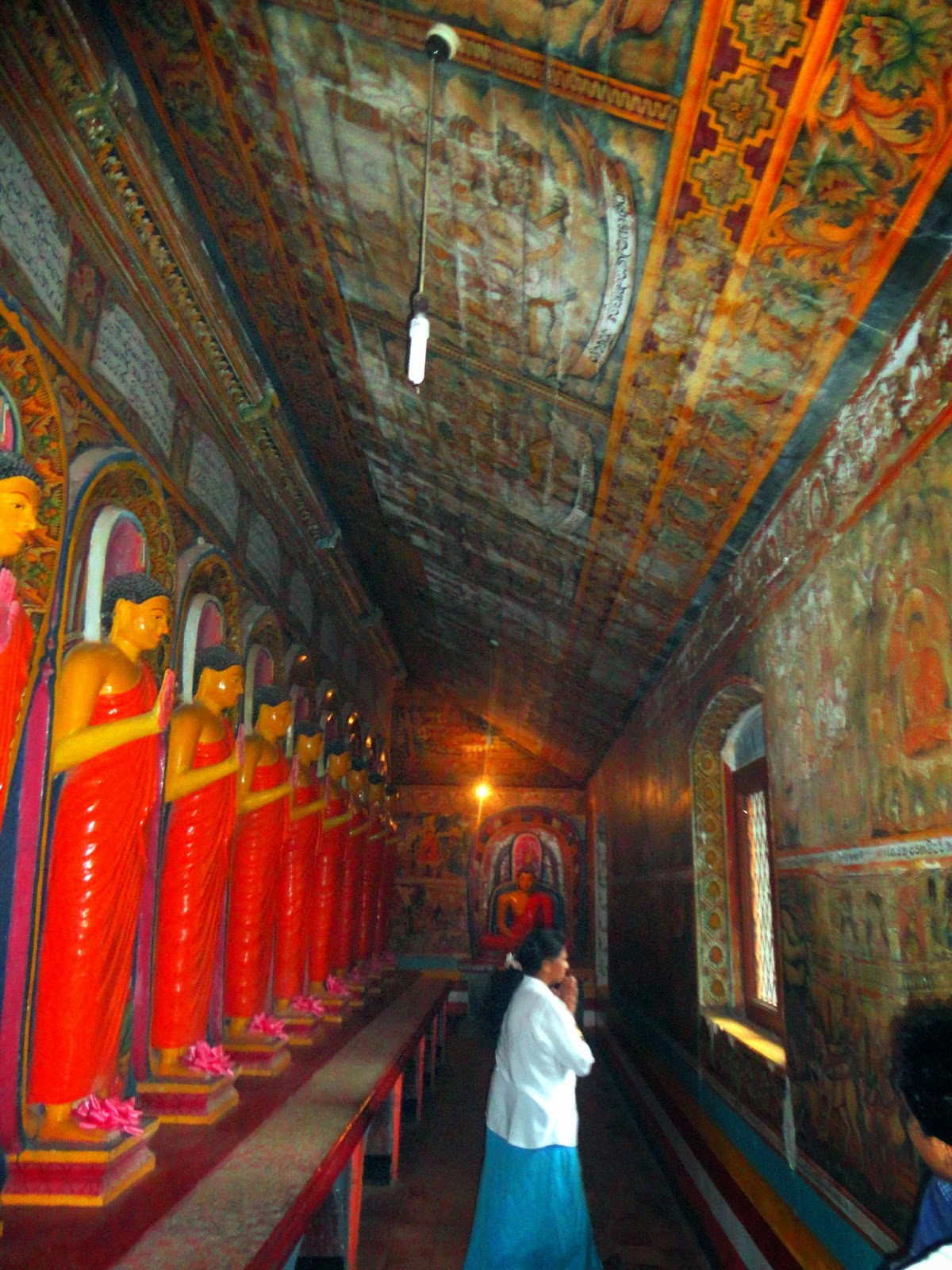
The Bo tree in this place is one of the eight saplings of Jaya Sri Maha Bodhiya. The main monument in Dadagamuwa Temple is the “Watadageya”. This Watadageya is one of the ancient and architectural places. The Dagaba within the Vatadage takes the shape of a water bulb (Diya bubula). According to some Villagers and web articles; inner walls have paintings of Jathaka Stories and were restored latter part of 19th Century. As per web articles, these original paintings belong to Kandy Era. The roof of Watadagaya consists of two tiers sloping in four directions. The top of the roof is crowned with a pinnacle. The remaining monuments in this place are “Nidangala” and “Padalassa gala”, show the archaeological importance of this Viharaya too.

Other than the old monuments, there is Standing statute of Lord Budha, which is 120 ft tall, is built recently. Viharaya is situated in flat land closer by a huge paddy field and scenery is eye-catching. One side of the Viharaya is boarding to a small Water Stream and it’s full of “Theppili” Fish. Other than these, Trees of enlightenment of all twenty-eight Buddhas have been planted around the Standing Statute of Buddha.